Blog Tour The Horsemans Song Ben Pastor

Blog Tour The Horsemans Song Ben Pastor 

Please help me welcome Author Ben Pastor to Beadyjansbooks today as part of the Blog tour for his brand new book The Horsemans Song.


The Horseman's Song is the 6th and final Installment in the Authors Martin Bora collection, however it is a prequel to the entire series so if you haven't yet read the others you could quite easily begin with this title as an introduction to this dramatic alternative viewpont of WW2.

The Blurb

Spain, summer 1937. The tragic prelude to World War II is played out in the civil war between Spanish nationalists and republicans. On the bloody sierras of Aragon, among Generalissimo Franco’s volunteers is Martin Bora, the twenty-something German officer and detective whose future adventures will be told in Lumen, Liar Moon and Kaputt Mundi. Presently a lieutenant in the Spanish Foreign Legion, Bora lives the tragedy around him as an intoxicating epic, between idealism and youthful recklessness.


The first doubts, however, rise in Bora’ s mind when he happens on the body of Federico Garcia Lorca, a brilliant poet, progressive and homosexual. Who murdered him? Why? The official version does not convince young Martin, who, more and more fascinated by the mystery, begins a perilous investigation. His inquiry paradoxically proceeds alongside that which is being carried out by an “enemy”: Philip Walton, an American member of the International Brigades. Soon enough the German and the New Englander will join forces, and their cooperation will not only culminate in a thrilling chase after a murderer, but also in a very human, existential face-to-face between two adversaries forever changed by their crime-solving encounter... 

Find Ben's page here http://www.benpastor.com/en/index.html

Here is an article written by Ben about the lead character Martin Bora:

On mysteries and salvation:
or, what is a man like Martin Bora doing in the uniform he wears?


        What is real about a character like Martin Bora’s, and where does he come from?
        Not easy to say. “Words, as is well known, are the great foes of reality.” So wrote Joseph Conrad in the opening of Under Western Eyes. The implication is that any conversation, or even language itself, could be a potential repository of lies, or at the least of non-adherence to the truth. Many years after Conrad, semiologist Umberto Eco (The Name of the Rose) theorized: “Every time there is signification, the possibility arises that it be used in order to lie.” Written language is doubly suspicious. What, then? The question of how real a literary character might be runs against the twofold obstacle of its being narrated, and in written words to boot.
        Yet, in my opinion, just as we have who knows how many perfect lookalikes among the nearly seven billion people now living, there must exist (or have existed) someone like Martin Bora. We never invent anything.

        This said, Martin-Heinz Douglas Wilhelm Friedrich von Bora, as his 1913 baptismal record reads, is a young man whose fictional adventures - between the ages of 23 and 31 - span the years 1937-1945. These are incidentally the years elapsing between the Spanish Civil War (1936-1939), great maneuvers for a global conflict, and the end of the Second World War (1939-1945). Aptly so, given that Bora is a career soldier. By choice. Yes, also by choice. But coming from landed gentry that always considered the profession of arms an existential source of pride, perhaps saying “choice” is not entirely correct.
        He grows up in the revanchist aftermath of the Great War, in a family of intellectuals and career officers, raised in the national myth of the “stab in the back,” which was for the younger German generations what the myth of a “mutilated victory” was for Italian nationalists. That is, a belief that their country deserved better from the immense disaster of war (victory in the case of the Germans, territorial gain in the case of the Italians) – if only the army had not suffered internal treason of various kinds, politically and racially identifiable. From a conservative but enlightened Saxon family, Roman Catholic notwithstanding his descent from Katharina von Bora - former Cistercian nun and Martin Luther’s energetic wife -  Bora has Scottish ancestors on his mother’s side, the proud blood of the Douglases who fought with William Wallace and Robert the Bruce.

        I have often had the opportunity to remark how Bora’s outline matches the character of  Colonel Claus Schenk von Stauffenberg (1907- 1944), Hitler’s unlucky would-be assassin. Dashing, highly educated, a music lover, the Catholic Stauffenberg is a romantic hero par excellence. Like him, other young aristocrats serving in the German Armed Forces (Yorck von Wartenburg, Werner von Haeften, the von Boeselager brothers...) distinguished themselves for their bravery on the battlefield as well as for their heroic participation in the Resistance, unto imprisonment, torture, and even death.
        However, I would like to point out the differences between Bora and his factual avatar. Bora’s painful awareness of his political choice, and the resulting process of opposition to  Nazism, is more rapid and less tied to the adverse fortunes of war. Also, it is displayed in daring, daily acts of disobedience (which we would term “civil” if the context allowed) to criminal orders. In this, he somewhat resembles Oskar Schindler, who was, even as Bora is, a member of German counterintelligence - the Abwehr - and who earned his place as “just among the nations” by saving from certain death his Jewish workers and employees in Poland. Furthermore, if Bora is an all-out soldier, stoic as his Victorian education demands, he is also a man of strong sexual impulses, which for a period of his fictional life find the perfect counterpart in his haughty, unabashed wife Benedikta. After all, didn’t they grow up in the jazz age, presaging the sexual revolution in the modern West?

        All this is preordained, it could be said, and a such, the product of a specific choice. Of course. Sketching Bora’s character (as also the protagonists of my other cycles, from the Late Roman soldier-historian Aelius Spartianus to the odd couple of Prague investigators, Solomon Meisl and Karel Heida), everything is option, selection, sorting out.
        As far is Martin Bora is concerned, what intrigues me most is to understand what others expect of him: family, teachers, wife, commanders, colleagues; what his conscience demands of him. If conflict is the essence of narrative, multiplying the levels of conflict can only raise the ante, all the more since Bora is not so much a man against as he is an individual whose education clashes only in part with the prevailing sentiment, the Weltanschauung of the culture around him.
        Elsewhere I observed that my principal task vis-à-vis Martin Bora is to try to save his soul. In truth, this is an undertaking that, one novel after the other, deeply involves Bora himself. If in its quality of “absolute evil” national socialism can be recognized (and so the weapons needed to fight it), not so easily defined are the boundaries of fervid patriotism, longing for national redemption, blind trust in an ideology seemingly intentioned to right wrongs and abolish unjust privileges. For Bora, family obligations, religious tenets, a severe academic and military upbringing, forge his individuality to the extent of making it into something quite different from what it was at birth. But isn’t it a fact that everything - that life itself- forges, shapes and potential distorts what each of us was in childhood?

        The notion of the Conradian double, an alter ego with whom the protagonist finds himself dialoguing or contending, is often resolved in literature (especially where mysteries are concerned) through the creation of stable or occasional investigative pairs. While in my Prague cycle Heida and Meisl - the young Austro-Hungarian lieutenant and the famous Jewish physician - constitute a constant duo, Martin Bora occasionally finds interlocutors-collaborators. Such is Father Malecki in Lumen, or Italian Police Inspector Sandro Guidi in Liar Moon and Kaputt Mundi, or political exile Luigi Borgonovo in The Dead in the Square. Down deep, however, Bora is a loner, even as characters in some great Western films (The Searchers is an example) interact fully with the world around them but remain intimately separate from it. The last frame in John Ford’s masterpiece, where an unforgettable John Wayne is shown walking away in the sun through the doorway of a dark interior (which is however home, family, comfort), is perfectly representative of the hero who never quite becomes “attached” to people or things, even when he has risked his life for them.

        In the series as developed thus far, from the fourth novel on Bora must face up to the serious injuries suffered during a partisan attack in northern Italy, namely the loss of his left hand. Given the Nazi cult of physical perfection, in view of a marriage relation based on mutual impeccability, wholeness and good looks, and because of Bora’s lifelong passion for piano music, the mutilation - even though it does not appreciably affect his military successes, much less his erotic prowess - is nearly unbearable. Thus in Bora’s journey there’s an identifiable before and after: in fact, more than one. There’s a before and after injuries, before and after Stalingrad’s hell, before and after Benedikta, and especially before and after his moral and political disillusionment. But please note, I was never interested in portraying Bora as a convert unrecognizable from his former self. I was never interested, nor am I interested in making him sanctimonious, politically correct, rehabilitated, normalized. Bora is and remains a faithful German soldier with all that “collective guilt” implies, a conservative and a patriot, a restless Catholic, a man in love with love for whom every relation eventually does not live up to the dreamed ideal.

        Detection, I am beginning to understand after seven novels and with number eight in progress, becomes for Martin Bora part of the business of living. Note: not of his military business (he is not a professional investigator, and often his inquiries are accidental), but of the very way he sets himself before reality. He is curious, attentive, notices the minutiae, the seemingly irrelevant detail; his senses are alert and his mind sensible and discriminating: his ideal brothers are in equal measure Natty in The Last of the Mohicans and the even-tempered Marlow in Heart of Darkness. The only literary investigator with whom he shares a recognizable trait - a tranquil melancholy veined with humor - is very different from him: Police Inspector Maigret.

        So, going back to the opening sentence: who knows what is real, and it’s hard to say where Martin Bora comes from. For me, he was born as every child is made, no matter if intentionally or by accident. Like a flesh-and-bone son, he has belonged to himself since birth. I limit myself to the acknowledgment of his qualities and defects, trying to relate them all without misrepresenting his nature. I continue to love him, feel for him and listen to him (he is too self-aware to need scolding), having for a long time granted him permission to come and go freely. The door for Martin Bora is always open, and even though I feel anxious for him, I do not place restrictions on him. I trust his decisions, or perhaps I believe that truly, sooner or later, his soul shall be saved.

Find The Horseman's song here available in paperback from 14th February.

Published by bitter Lemon Publishing.

Blog Tour East of England by Eamonn Griffin - guest post

Blog Tour East of England by Eamonn Griffin


Today I welcome author Eamonn Griffin to Beadyjansbooks as part of the Blog Tour for his brand new "East Coast Noir" thriller - East of England.


He has written this fab article for my blog where he shares his thoughts on writing in movies ... It's hardly surprising that Stephen King features as it's clear the darkness in his books have seeped into Eamonns deliciously dark writing style.

Please read the article he has so kindly provided and then go read his dark and thrnew book. East of England which is available now in paperback and kindle editions.

The Blurb:

Dan Matlock is out of jail. He’s got a choice. Stay or leave. Go back to where it all went wrong, or just get out of the county. Disappear. Start again as someone else. But it’s not as simple as that. 

There’s the matter of the man he killed. It wasn’t murder, but even so. You tell that to the family. Especially when that family is the Mintons, who own half of what’s profitable and two-thirds of what’s crooked between the Wolds and the coast. Who could have got to Matlock as easy as you like in prison, but who haven’t touched him. Not yet.

Like Matlock found out in prison, there’s no getting away from yourself. So what’s the point in not facing up to other people?


It’s time to go home.


Author Eamonn Griffin


Find Eamonn on Twitter @eamonngriffin

Eamonn Griffin on movies about writing

Because I write, I’m interested in writing. There are loads of movies about writing and writers, for example.

Sometimes, it’s because the job (if it is a job in the ordinary sense of the word) seems to allow that character to have time to explore whatever the rest of the plot of that movie is. Sometimes, though, the movie is about writing itself, or at least about how writing is a struggle for that author. That’s there the conflict of such movies, is. A writer doing writing is pretty boring to watch. It’s indistinguishable from typing. But a writer not writing? There’s fun to be had there. So here’s a few favourite films that play with this idea:

American Splendor (2003): the true-ish story of Harvey Pekar, a lowly administrator who documents his dull life and his awkward romances in a series of graphic novels, and becomes a minor celebrity in so doing.

Prick Up Your Ears (1987): a film about the playwright Joe Orton and his partner Kenneth Halliwell, played by Gary Oldman and Alfred Molina. As Orton’s career takes off, Halliwell’s own writing stalls, and this is part of the collapse of their relationship, leading to murder/suicide.

Before Sunrise / Sunset / Midnight (1995/2004/2013): Richard Linklater’s trilogy of movies about Jesse (he’s the writer here) and Celine - played by Ethan Hawke and Julie Delpy – who meet up for a few hours at different points in their lives. Not much happens, and that’s sort of the point.

Misery (1990): One of several Stephen King adaptations - like Secret Window, The Shining, and The Dark Half – that explore the horror in the writer’s life. Here, it’s
the obsessed fan story, as James Caan’s successful romance author gets himself held prisoner by superfan Kathy Bates who is insistent (really, really insistent) that he resurrects his recently-killed off series heroine for one last novel.

Adaptation (2002): Charlie Kaufman (played by a never-better Nicolas Cage) has writer’s block when trying to adapt a delicate novel into a screenplay, so he turns to his action genre-oriented brother Donald (also Cage), for reluctant help.

Wonder Boys (2000): Michael Douglas’s university lecturer character is stuck writing his second novel, years after having a single success, so he too looks for help ending up on a road trip with his literary agent and a talented young writing student.


There are plenty of others, of course, from biopics of famous writers (or sometimes, of the writing of a great novel or play) to stories which use the idea of a writer character as a way to explore the plot and character concerns of the movie in question. The crime writer as detective, for example is an often-used example. 

If you’ve got a film that for you is interesting / funny / perceptive about writing, then mention it in the comments below!


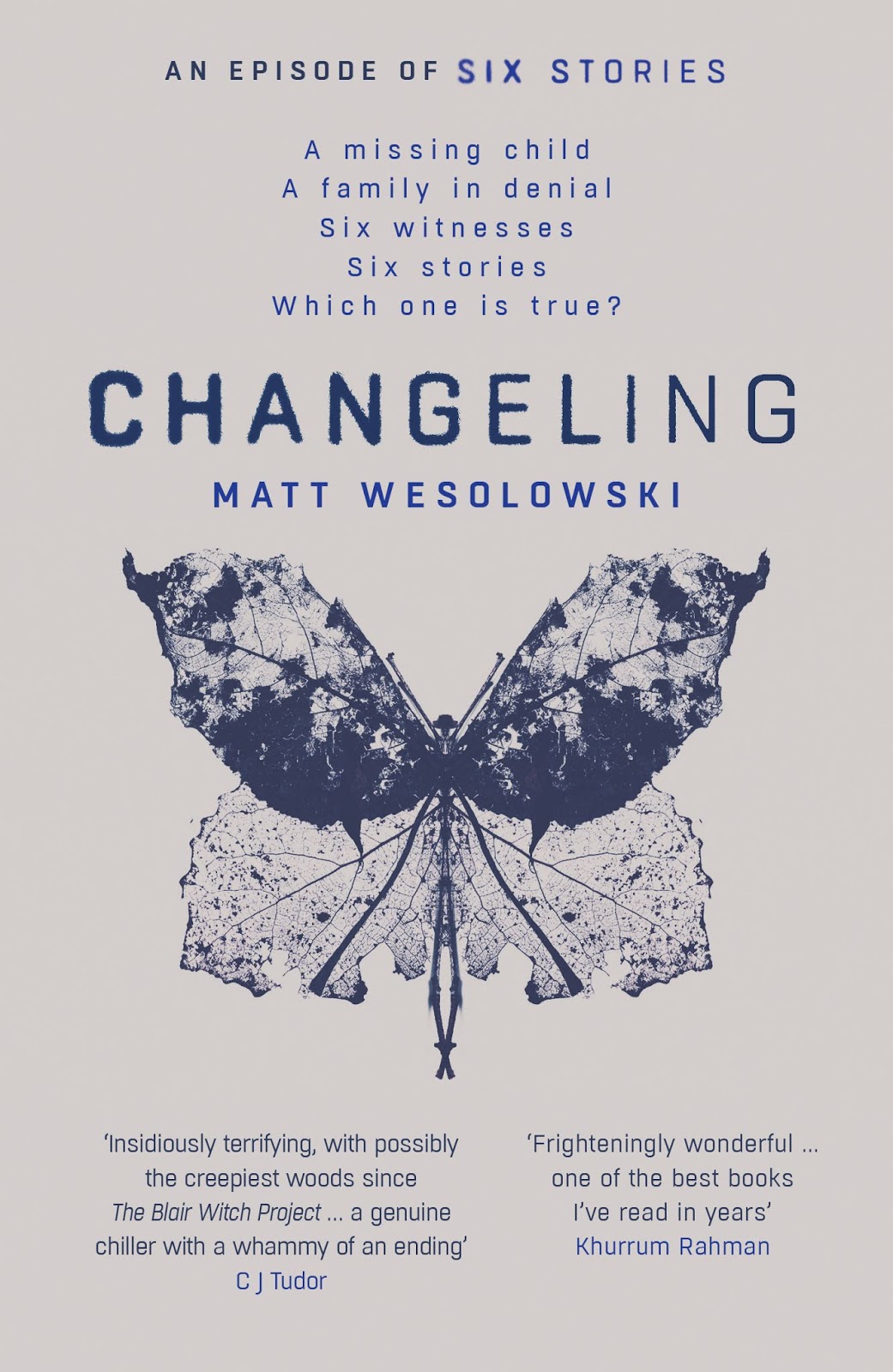
Blog Tour and my Review - The Changeling - Matt Wesolowski - chilling

Blog tour - The Changeling by Matt Wesolowski.

I'm delighted to have been invited along on the blog tour for the latest in the Six Stories series by Matt Wesolowski and in my opinion even better than it's predecessors, Six Stories and Hydra. 


My Review:

Being near the tail end of the blog tour, I've had to exercise a higher than usual amount of self-discipline and resist reading too many other reviews in case they influenced my review.

I have, however, seen lots of social media posts saying how fabulous this book is and I concur. It is scary and chilling and has a real twist in the tail I didn't see coming, in fact, it swiped me sideways and left me reeling and my ears are still ringing.

It is an emotive read, any book about a child who goes, and remains missing is sure to tug at anyone's heartstrings. It is menacing, coercive and really, REALLY, eerie and dark. 

Little Alfie Marsden goes missing in the spooky and legend-ridden Wentshire Forest whilst on a journey with his father Sorrel. When Dad stops to check the car engine, Alfie is on the back seat, when he gets back in the car the little lad is no longer there, he has disappeared, leaving no trace and few clues to where he may have gone. That was back in 1988 and despite recurring searches of the forest he has never turned up and back in 1995 Alfie was declared dead. But the mystery remains.

The story fascinates Six Stories podcaster Scott King and he decides it will make a great addition to his podcast which investigates unsolved mysteries by providing insights from 6 witnesses to an event, but he fears he may have bitten off more than he can chew with this mystery as it begins to suck him deeper and ever deeper. 

He interviews many different people involved, some of whom tell terrifying tales which have haunted the forest for years and seem to point to frightening occurrences involving the supernatural. Witches, fairies and creatures of the forest have been talked about and spooky events experienced by many and as the stories tumble forth from the interviewees the tension builds, subtly and imperturbably and as I realised my jaw was clenched as I was reading it so does Scott begin to feel he may be getting too close for comfort. As he tries to do the job he does so well and reveal what happened to little Alfie, he uncovers some brutal and terrifying facts as word by word and interview by interview he draws closer to revealing where Alfie really went.

Peopled by possibly unreliable witnesses - a team of builders scared out of their wits, an alcoholic Mum addicted to numbing her pain with alcohol, people who knew Alfie at school, he even interviews the enigmatic and charming Sorrel and we meet many more truly phenomenal characters throughout this very disquieting book.

Changeling took me by the hand and steered me off down an eerie path through the woods, until I was so wound up and involved that a mere tapping noise close by nearly made had me wetting myself! I'm feeling breathless just writing this and recalling the way it made me feel. After all isn't that what every great should do - make you FEEL the story not just read it

Even though I thought I knew where I was being led, I ended up somewhere even more disturbing! The Changeling is a very clever, manipulative, contemporary tale which captivated and enthralled me. It explores some sinister themes and is thoroughly perplexing throughout. 


The Blurb and some quotes:

On Christmas Eve in 1988, seven-year-old Alfie Marsden vanished in the Wentshire Forest Pass, when a burst tyre forced his father, Sorrel, to stop the car. Leaving the car to summon the emergency services, Sorrel returned to find his son gone. No trace of the child, nor his remains, have ever been found. Alfie Marsden was declared officially dead in 1995.

Elusive online journalist, Scott King, whose ‘Six Stories’ podcasts have become an internet sensation, investigates the disappearance, interviewing six witnesses, including Sorrel, his son and his ex-partner, to try to find out what really happened that fateful night. He takes a journey through the trees of the Wentshire Forest – a place synonymous with strange sightings, and tales of hidden folk who dwell there. He talks to a company that tried and failed to build a development in the forest, and a psychic who claims to know where Alfie is…

Intensely dark, deeply chilling and searingly thought provoking, Changeling is an up-to-the-minute, startling thriller, taking you to places you will never, ever forget.


‘Bold, clever and genuinely chilling with a terrific twist that provides an explosive final punch’ Deidre O’Brien, Sunday Mirror

‘A genuine genre-bending debut’ Carla McKay, Daily Mail

‘Impeccably crafted and gripping from start to finish’ Doug Johnstone, The Big Issue


‘With a unique structure, an ingenious plot and so much suspense you can’t put it down, this is the very epitome of a must-read’ Heat

The Changeling is published by the wonderful Orenda Books who provided my copy.

You can order one from Amazon and good book stores.


The Author - Matt Wesolowski

Matt Wesolowski is an author from Newcastle-Upon-Tyne in the UK. He is an English tutor for young people in care and leads Cuckoo Young Writers creative writing workshops in association with New Writing North. 


Wesolowski started his writing career in horror and was a winner of the Pitch Perfect competition at 'Bloody Scotland'; Crime Writing Festival 2015. 


Review - The Almanack - Martine Bailey - luscious historical mystery

The Almanack by Martine Bailey


My Review

The Almanack is a luscious and vibrant journey into the past via the predictions and riddles of an almanack.

One of the first things I notice when I sink blissfully into a Martine Bailey book, is how quickly she transports me to another era and how evident it is that she has deeply researched everything to do with the era she is writing about. Which, in this case, is the mid 1700s.

The whole book is cleverly constructed around an Almanack of the very year in which the book is set and is so authentically woven I can only surmise that the Author had such a real document in her hands at the time of writing. 

An Almanack is a printed yearbook containing dates and events for the coming year, more detailed than a calendar or a diary it would contain notable festival dates, sunrise and sunset times, tide tables and other information invaluable, especially to country folk, farmers and the like. Some are still printed every year to this very day, for example Whitakers Almanack. As relevant now as ever, in those dark days before mobile phones, the internet and tv and radio, how else could one keep track of dates, events and timings? The Almanack in question must have been treasured by those lucky enough to get hold of one, as it sought also to entertain and amuse, by predicting weather and featuring some really clever riddles.

Our heroine Tabitha Hart seems at first appearances to be no better than she should be, a flibbertigibbet, a prostitute, who wakens to find the punter she spent the night with has absconded with her belongings, her money, even her outdoor garments! But never mind she in turn fleeced him and has in her possession a very distinctive and unique pocket watch in the shape of a grinning skull.

This doesn’t really help much now though as she continues her journey back from London to her rural home in the small village of Netherlea to visit her Mother, who has sent an urgent appeal for her to come home quickly. The money she had in hand was owed to her Mother and the clothes she has lost were her veneer of respectability. She arrives in her home village of Netherlea, bedraggled, penniless and dishevelled, indecently clad in little more than a petticoat. To her horror and regret she finds she is too late, her Mother is dead!
Tabitha suspects foul play and vows to discover who was watching her Mother and who was behind many cryptic messages pointing to the identity of whoever may have murdered her but she gets embroiled in all manner of intrigue. She aligns herself with budding writer and man of mystery Nat Starling. But as deaths continue, many with suspicion surrounding them she gets ever deeper embroiled in danger and crime.

I don’t want to give away too much of this absolutely delightful, original and unique historical thriller which ticks every single box to be a firm favourite for me. Great historical detail, wonderful richly painted characters, tons of mystery and intrigue, masses of twists and a narrator who you know is hiding something and whom you aren’t sure whether to despise or love (clue - I ended up loving Tabitha) 

A rich, beguiling tapestry of 18th century suspicion and mistrust, overlaid with a touch of romance and a few murders and you have the perfect novel to while away any rainy weekend.

Overlaid with tons of cunning riddles, each chapter begins with one and you don’t get the answers until the end of the book, I predict The Almanack will delight and enrapture many a reader.

Available at the end of January from good booksellers.

The Blurb

The philosophy of time, destiny and the stars pervade this intricate historical mystery in which a young woman determines to avenge her mother’s death. 1752, Midsummer. 

Following a desperate summons from her mother, Tabitha Hart departs London for her home village of Netherlea – only to discover that her mother has drowned. Determined to discover the truth about the Widow Hart’s death, Tabitha consults her almanack and uncovers a series of cryptic notes describing her mother’s terror of someone she names only as ‘D’. 

Teaming up with young writer Nat Starling, Tabitha begins a race against time to unmask ‘D’ before more deaths follow. But as the summer draws to a close and the snow sets in, cutting off Netherlea from the outside world, Tabitha and Nat are forced to face the darkest hours of their lives. With the year predicted to meet a ‘violent, bloody end’’ will Tabitha survive long enough to bring her mother’s killer to justice?


Ideal Angels - blog tour and Extract

Ideal Angels - blog tour and Extract:

Today I am part of the blog tour for the new book by Robert Welbourn - Ideal Angels.


BLURB  

Is it possible to keep secrets in the age of social media? 
When someone lives their entire life in the spotlight, what could they possibly hide from you? 
Ideal Angels explores just that. It s the story of one man, one woman, one week. 
They meet, fall in love, and never look back. 
Eloise's phone is never far away, furiously cataloguing their ups and downs. But there are always shadows, lurking just out of reach. 
The moments after the camera flashes, unseen, uncaptured. 
The threat of an inescapable doom. 
How much can one person change you? 
How much can one person be your downfall?


Robert Welbourn


ABOUT THE AUTHOR: 

Robert Welbourn is Yorkshire born and bred - he's lived there almost all his life, and now written a book set there. He’s had a passion for books as long as he can remember, and has been writing his whole life. 
His favourite authors are Bret Easton Ellis and Stephen King, and he cites Ellis as his number one influence.
He studied English Literature at Salford University, and this confirmed that he wanted to spend his life working with books. He currently works in marketing, but is hoping to spend his life telling stories.
Twitter @r_welbourn

Now here's an extract to whet your appetite:

That familiar burn, the sting in your nostrils, the supreme energy and
confidence, you haven’t felt this in a long time. It isn’t long before the
coke talk begins, and though it’s usually bullshit, this time it’s actually
interesting, you’re actually listening. And listening is all you’re
doing, because she’s practically ranting. Yeah so you’re probably wondering
about the hotel well my parents own it well not own it it’s sort of like franchised nothing official but basically they put a lot of money into it
and take a lot of the profits and they’ve done this all over the world and the
penthouse is owned by them but I don’t think they’ve ever been here except
maybe once just after they first got it. She breathes. And yeah so I come
here a lot it’s technically where I live well it’s one of my homes I guess my
official home is in the States with my parents but I don’t really like it there
it’s too hot and the people are all annoying so I have most of my stuff here
but really I spend all my time in my other place near the art school I’m going
to near where we met. She stops talking briefly, another massive line,
then more words, she’s like a waterfall. So yeah that’s the hotel and that
explains the car too and why I don’t go to art school very often I mean I
know I should but it’s hard to see a point in it you know to me the point is
looking good, feeling good, people knowing you look and feel good and that’s
why I’m always photographing you and me and stuff and that’s why the
drugs too I love my parents don’t get me wrong at least I think I do, well I
know I should anyway but they’re never around and it makes me feel pretty
shitty but with this stuff, she indicates the bag, with this stuff it kind of
doesn’t really matter so yeah do you know what I mean?
You’re sort of blown away, you’ve been pacing to try to dissipate
some of the energy but it’s not really done anything, you’re
ridiculously high considering how early it is in the afternoon, and
you stop pacing but only for a second to look at her, and you
know she wants an answer but none comes to mind, and so you
grab her arm and pull her to her feet, to you, and kiss her hard,
probably too hard but you’re both so coked up it seems the right
thing to do. You can feel your erection but this isn’t the time,
not now, so you let her back down to the floor and take the note
from her and do a massive line yourself.
The late afternoon and early evening sort of pass in a haze and
before you know it you’re out, in the town, wearing the same
clothes you’ve had on all day and you’re unshowered since this
morning but you don’t care, you’ve got pure confidence in your
veins and so the two of you are walking, practically strutting
down the street, you have a cigarette but you’re not paying it
much attention, except to make sure none of the ash goes on your clothes. You come to a bar, The Oyster Bar, not the most fashionable
but reasonably discreet, and soon you each have a largely
ignored drink in front of you, and while she sits and texts and
makes the occasional call you just sit, look around, wanting to
go outside, breathe the air, expend some energy, but not wanting
to not be by her side. She says some of her friends are coming,
she hopes you don’t mind, and you say it’s chill, it’ll be nice to
meet some of the people in her life, and because of the drugs she
laughs but you actually mean it, you don’t want to let this one
go, you want to get your hooks into her. You know that’s an
awful way of phrasing it to yourself but you also know it’s true,
and so when her friends arrive you pretend not to be high, which
you’re not really much anymore anyway, you’ve purposefully not
been bumping in order to not make a bad impression. Her friends
are just like her: slim, beautiful, phones out, drinks out, but from
the looks of them they’re not currently reading Ulysses; in fact
you wonder if they can read at all.
You let them talk, it’s mostly about you, Eloise’s friends interrogating
her about you, but she’s ducking questions, trying to
avoid the fact she doesn’t actually know much about you, and by
now the coke has worn off and so you drink your drink, then
drink another, and soon you’re pretty buzzed off the alcohol. A
couple of her friends look familiar, you feel like you’ve seen them
before, but you chalk this up to the alcohol. That sense of familiarity
a slight buzz often brings. Is it the alcohol? Do you care?
You sense Eloise is buzzed too from the way she’s looking at
you, lust tinged with desperation, but regardless her phone is out
and her friends’ phones are out and it’s all selfies, group photos,
you’re dragged into photos by people whose names you don’t
even know, faces you won’t remember, and you’re thinking it’s
all so cheap, this is all so vague and unnecessary, but you let it
happen anyway. You know Eloise is like this, you’re just glad it’s
not as much as her friends are.
Soon Eloise is taking your hand and you’re outside, leaving the
bar, moving on to the next. You light a cigarette for the walk
and give one to Eloise but soon all her friends are asking, begging cigarettes from you, and it just seems easier to give them all
one and so you do, and they’re coughing and looking unsure but
they’re all so proud of themselves, this small act of drunken rebellion
making them feel like better people, even though you know
if anything it’s the opposite. The next bar is Footage, you’ve not
been here for a while, but nothing much has changed. This bar
is more crowded, and despite being drunk you practically beg
Eloise and she takes you into the disabled toilet and you do a
bump each, two, and once you’re back in the room everything
seems much easier to handle, it’s given a perspective that means
something to you, or at least feels like it might. Her friends have
attracted a lot of attention but you and Eloise stay on the periphery,
not wanting to be antisocial, but not wanting to be involved.
Drinks are ordered and drunk, bumps are discreetly done, and
soon it’s the early hours and you’re tired, your nose hurts, your
head is spinning, you’re dreading tomorrow, dreading your exposure
to the world under the influence of such solicitous inebriants.
But in reality you’re back in the penthouse and it’s just you
and Eloise, you’ve managed to kick out her friends, and their new
friends, and it’s just the two of you and you go to the toilet, to
actually use the toilet for a change, and when you come back
Eloise has left the living room. You head for the bedroom and
find her standing in a pile of clothes, wearing only her pants, and
this time she does actually pounce on you.


Available on Amazon, click here for more details


Review - Wakenhyrst - Michelle Paver

Wakenhyrst - Michelle Paver

My thoughts:

Here's a lovely gothic style historical novel to tempt you to stay up late reading under the covers. It's not a horror story as such but a creepy tale of madness and loneliness.


I find the cover quite enticing with the silhouette of a Magpie (Oh, Chatterpie!!) and are those drops of blood?

Wakenhyrst is the story of a young woman Maud, brought up by her bullying father in a large old house around the turn of the 20th century, after the death of her mother in bloody childbirth. Maud is a very lonely young woman, forced to grow up quickly, she has few real friends. An intelligent young woman, when intelligence is the province of the male members of a family line, this does her few favours, apart from earning her a little grudging respect from the unpleasant and unpredictable father she nevertheless longs to impress.

He "allows" her the doubtful privilege of transcribing his historical research into local lore and a book about a woman thought to be possessed he becomes fixated on after finding part of an old painting belonging to the local church known as a doom.

He grows fixated and fearful and Maud in turn begins to fear for his sanity and possibly her own. Her only companions are the household servants, (one of whom she longs to be closer to and one who betrays her) and a bird she rescues and grows to love. She is forced to witness her Father growing increasingly more unpredictable and when she discovers his journal what she reads there makes her blood run cold.

It's a creepingly sinister tale, with a real twist in the tail I didn't see coming and a haunting sadness that had a lump in my throat. The story is told retrospectively by a researcher who comes to interview Maud in her old age and in this it reminded me of The Thirteenth Tale somewhat, it also has overtones of The Essex Serpent.

If you liked either of these books you will most probably enjoy Wakenhryst immensely as did I. It's a very credible and atmospheric coming of age story with a very dark core. I was rooting for Maud all the way, loathed her father and loved the watery fenland location its set in.

The Blurb

1906: A large manor house, Wake's End, sits on the edge of a bleak Fen, just outside the town of Wakenhyrst. It is the home of Edmund Stearn and his family – a historian, scholar and land-owner, he's an upstanding member of the local community. But all is not well at Wake's End. Edmund dominates his family tyrannically, in particular daughter Maud. When Maud's mother dies in childbirth and she's left alone with her strict, disciplinarian father, Maud's isolation drives her to her father's study, where she happens upon his diary.

During a walk through the local church yard, Edmund spots an eye in the undergrowth. His terror is only briefly abated when he discovers its actually a painting, a 'doom', taken from the church. It's horrifying in its depiction of hell, and Edmund wants nothing more to do with it despite his historical significance. But the doom keeps returning to his mind. The stench of the Fen permeates the house, even with the windows closed. And when he lies awake at night, he hears a scratching sound – like claws on the wooden floor...

Wakenhyrst is a terrifying ghost story, an atmospheric slice of gothic, a brilliant exploration of the boundaries between the real and the supernatural, and a descent into the mind of a psychopath.

Blackberry and Wild Rose - Sonia Velton - Review and Blog Tour

Blog Tour - Blackberry and Wild Rose by Sonia Velton


Blackberry and Wild Rose was one of those books which could have been written just for me. I read the advance copy I felt so privileged to receive last in 2018 and immediately needed to shout aloud just how much I LOVED it. In fact it made it on to my top ten reads of 2018.

I was therefore delighted to be invited along on this blog tour to help promote and raise awareness of this book, which is great as I want EVERYONE to get their own copy and love it as much as I did.

Here's my review, again, and I urge you to read it too.

My Review

Anyone who knows me, even the tiniest bit, will know, as surely as I did the minute I saw the cover of this book, that it is exactly the kind of book I fall head over heels in love with.

And I did. For several reasons...


(1) I swooned when I saw the absolutely gorgeous cover art. I am loving the current trend for historical novels to have a rich tapestry of all-over design and this one is covered with a lavish illustration of the woven floral silks which wind their way through the story.

(2) it is highly recommended by one of my very favourite authors the sublimely talented Laura Purcell whose book The Corset also made it on my top ten reads. (If she told me I'd enjoy reading the labels on sauce bottles, you wouldn't be able to get in my kitchen for ketchup and pickles)

(3) It is set in England, Spitalfields, London to be precise, in the late 18th century - Mmmmm it's piqued my interest.

(4) it is peopled with strong, willful women, who are all utterly believable and their stories individually are compelling. When they begin to overlap and weave together, the chemistry ignites causing an explosive tale of betrayal, deceit, ambition and politics that had me reeling.

(5) It is a luscious, competent and exciting debut brimming with the promise of so much more to come, from this author, who is a wonderful discovery.

So, you will gather, I liked it! I hope you'll be intrigued enough to put this book on your 2019 wishlist. Let me tell you a bit about it to whet your appetites:

It is the 1760s and we are in the city of London where Spitalfields, an area filled with merchants houses occupied by Huguenot weavers, jostles side by side with less wholesome neighbours, including brothels and pubs and a bustling marketplace.

Into this area arrives innocent young woman Sara, fresh from the countryside, smarting from what she sees as rejection by her Mother, just wanting someone to care for, brimming with hope for a new life and ready to seize any opportunity which comes her way.

But before the dust even settles she is "helped" by a wily old madam and inveigled into living and working at a notorious brothel.

Esther's life is very different, a respectable married woman living in one of the tall merchants houses with her Huguenot silk weaver husband, although her marriage lacks in love she hopes her husband will understand her desire to be involved in his world and reveals her ambition to be a designer of silks by showing him the delicate floral designs she has drawn. When he scorns and belittles her aspirations, she resolves to make her way despite him not because of him.

A foray into philanthropy sees Esther trying to help their less fortunate neighbours, and whilst distributing Bibles in the poorer quarters of Spitalfields she comes across Sara being bullied by her Madam and takes a chance on offering the girl employment as a maid.

Sara finds attending to the mercurial merchants' wife little less tiresome than lying down for a living, but she manages to make the best of what she's offered and a tentative friendship of sorts, begins between the two women.

But men, as they always do, disrupt the womens lives as they become embroiled in sinister and dastardly doings in the world of silk weaving and still Esther harbours her passion to create her own designs. 

There is very much a sense of who is using whom and why. Everyone has ulterior motives, nobody is perfect and those with minor imperfections meet the deeply flawed head on as we are treated to a whirling and writhing tale of dishonesty, abandonment, determination and recklessness.

It follows therefore that I am urging you to read this book because I ADORED it and if you follow my blog and like similar books to those I enjoy you will love it. It is clever and cunning, literary without being preachy, lush and lavish and never prosaic and it lulls you into several senses of false security before leaving you reeling.


Marvellous.

The Blurb:

When Esther Thorel, the wife of a Huguenot silk-weaver, rescues Sara Kemp from a brothel she thinks she is doing God’s will. Sara is not convinced being a maid is better than being a whore, but the chance to escape her grasping ‘madam’ is too good to refuse.

Inside the Thorels’ tall house in Spitalfields, where the strange cadence of the looms fills the attic, the two women forge an uneasy relationship. The physical intimacies of washing and dressing belie the reality: Sara despises her mistress’s blindness to the hypocrisy of her household, while Esther is too wrapped up in her own secrets to see Sara as anything more than another charitable cause.


It is silk that has Esther so distracted. For years she has painted her own designs, dreaming that one day her husband will weave them into reality. When he laughs at her ambition, she strikes up a relationship with one of the journeyman weavers in her attic who teaches her to weave and unwittingly sets in motion events that will change the fate of the whole Thorel household.

If you don't want to take my word for it here is what other people have said about Sonia Veltons novel:

For fans of Jessie Burton and Tracy Chevalier, a rich historical debut set among the Huguenot silk weavers of Spitalfields in the late 18th century

'Sumptuous and moving. Velton weaves her tale with the threads of betrayal, thwarted dreams and good intentions gone awry' Laura Purcell

'A richly imagined and brilliantly twisty tale' Anna Mazzola

'A plot as finely detailed as Spitalfields silk' Stacey Halls

About the Author:

Sonia Velton grew up between the Bahamas and the UK. 
After graduating from university with a first class law degree, she qualified as a solicitor at an international law firm, later going on to specialise in discrimination law. Sonia relocated to the Middle East in 2006. Eight years and three children later she returned to the UK and now lives in Kent. 
Blackberry and Wild Rose, inspired by real characters and historical events, was short-listed for the Lucy Cavendish Fiction Prize as a work in progress, was longlisted for the Mslexia novel competition, and is Sonia's first novel.

The book is published by Quercus and you can find it here or order it here